Can two nerds do it? Take the most epic journey across the Final Fantasy Universe ever? Can they avoid being knocked down in I, find the first Chocobos in II, play the long, lost forgotten cousin III, cleanse their soul in IV, save the crystals in V, blabber on and on about how great VI is, and then go beyond, into the world of 3D, emo, and fantastically absurd hair? Read, and find out!

Showing posts with label deep insights. Show all posts

Wednesday, April 2, 2008

Light Warriors? Not anymore, mothafucka!

Hey, you guys! Isn't it great that Squaresoft has gotten all progressive with this game? They love the environment, they LOVE the gays (getting to that soon!), and... hey! Look! A black guy! And he's always there to make some sort of sassy, hip comment that is totally off the chain. Look, he knows how to tell it to the Shinra:


And why the %$#@! should he bother with that bitch Jenova? He's got bigger fish to fry.


Barret knows the value of some well-placed punctuation.


So we at Blogging Final Fantasy salute you, Barret. You have broken the Final Fantasy color barrier, if not the anime trope that one character per anime must have at least one mechanical limb.


We shall overcome, my friends. We shall overcome.

Monday, November 5, 2007

A treatise on Kefka, pt. 1

Kamarile and I talk about a lot of Final Fantasy (more so since the Advent of our Blog), usually when I'm at work on a conference call and am desperate for something to break the tedium of my day to day life.

Today, I threw out a comment about which Final Fantasy was the darkest. I think it's something I'll revisit, but, it got me thinking about Kefka. Kefka, you see, crosses the line between everyday villany, and cartoonish super-villany.

Before I get too deep into this, think back to our villains of Final Fantasies past.

Final Fantasy 1 has an evil being (Chaos), who creates a time paradox in order to live forever.

Final Fantasy 2 is essentially Star Wars, Episodes IV and V, complete with evil emperor trying to take over the world.

Final Fantasy 3 is you fighting a big mean cloud and trying to restore the balance of the Crystals -- and the world!

Final Fantasy 4, I think, is where we start getting a little more evil with our villains. Golbez is essentially trying to transplant all of the moon people onto the Earth, and thinks he has to kill all the humans to do it.

Final Fantasy 5, of course, has X-Death, an evil wizard imprisoned in another dimension because he's a bad, bad boy. (He's also a fucking tree. Don't forget about that part. -Kammy)

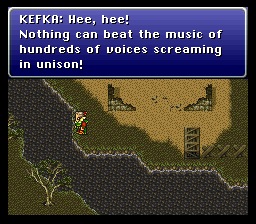
FFVI064 Kefka is ridiculously evil.


Now, let's take a look at Final Fantasy VI. We've got Kefka. Who, clearly, is our major villain, as he's evil, and has the most memorable speaking lines.

This? Is a person who revels in death. Now, I know what you're thinking. Gee, Matola, there are other villains who enjoy killing their adversaries. This? Truth.

The difference, in my mind, is that Kefka doesn't care who he kills, so long as they die in a horrible, painful manner. Friend, foe, ally, enemy? Doesn't matter. The only thing that DOES matter is a swift, painful death.

Final Fantasy 6 is a landmark game to me in a lot of ways. I think that you'll find that you can classify a large majority of FF Fanatics into one of three groups.

The first group is those that played FF1 when it first game out, or got into the genre with Dragon Quest 1. The second would be the group who joined in the SNES era, and consider this to be the pinnacle of gaming. The third played FF7 when it game out on the PS1 and think it's the pinnacle of gaming. [I assume there might be a fourth group that started on FFX. Note no such comment of it being the pinnacle of gaming].

The other, more interesting thing to me, is how flippant Kefka is. And, I can't explain it, but this behavior that is almost the complete polar opposite of the above? It makes Kefka more believable to me. Or, perhaps, I can say, more human, despite how inappropriate that sentence may seem.

Kefka subscribes to the principle of vengeance at any price. He wants to be the best, and he obviously wants to have a damn good time while he does it. Very human, I think. The problem, though, is a complete and total lack of a moral compass.

And, actually, morality, to me, is the overarching theme behind the game. Some games are about 'love', and 'hope', but this one? It's all about fighting for what's right. And that's why Kefka, and by extension, FF6 is such a great game.

Because, when it comes down to it, haven't we all heard that little voice in the back of our head, cackling madly and telling us to give into our baser impulses?

I know that I have.
FFVI059
I bet you've seen this screenshot before!

Sunday, November 4, 2007


You may notice that Matty and I have chosen to play the original version of FF6, the one released in North America for the SNES as Final Fantasy 3. There is now an alternative version of this game for the GBA (the Playstation one doesn't count, because it is lame.) Now, we are not purist snobs here at FFNerds, and we love FF6 Advance accordingly. Here are some of the awesome features that FF6A has that FF3us does not:

1) A high-difficulty bonus dungeon after you beat the game, which is nice, since FF6 is an easy game where a lot of the time, unless you're doing specialty challenges, you never get to use half of your Kewl Powerz.


2) Extra espers, the coolest of which is a Cactuar esper that gives you Quick (Haste2 and +2 speed at level --Matty) and is a tricky fight. (Gilgamesh appears, although without his theme song, which instantly makes him less cool.)


3) You can play it on the bus.

4) The best feature of all this, however, is a brand new official translation, which to the best of my knowledge is more faithful to the original Japanese. This translation breaks away from a lot of what fanboys perjoratively refer to on the internets as "Woolseyisms" that pepper the game text of FF3us.


Now, let's talk for a minute about Ted Woolsey. He's the guy responsible for the official English translations of most of the 16-bit Squaresoft classics: Final Fantasy 6, Chrono Trigger, Secret of Mana, and Super Mario RPG. He would translate chunks of game text, out of context, all by his own, and was given pretty small amounts of time to complete these translations. And this game text also had to comply to Nintendo's pre-game ratings system of censorship, which basically existed to make sure that no parent could possibly be offended enough by a game to lead to a possible lawsuit. Not only could games not be too violent, they also had to avoid touching on death, sex, or religion. Not talking about death seems like a tall task in a game where your goal is to, I dunno, stop a villain from killing people, and where a PC's wife and small child are wiped out with his entire country in a cutscene, and where another PC tries to kill herself after she believes that everyone she loves is dead. It's hard to even repeat that sentence without using the words "kill" or "dead" at some point, and yet Ted Woolsey manages this for the entire game. And it's not like he does this by changing events in the game. In the image to the right, for example, we still learn that Cyan's wife and kid have just drunk Kefka's poisoned kool-aid of death. Woolsey just has to cleverly replace the word "die" with such euphemisms as "leave me," "be defeated," or "pass away."


Another problem? space constraints on the cartridge. You notice a lot of lines of dialogue that are written to use the bare minimum of characters, and monster names bear the brunt of the squishing. This means a lot of people in FF6 will replace "them" with "em," for example. It also means that fearsome monsters like TunnelArmr are allowed to run about with impunity.


Despite, and perhaps because, of these setbacks, Woolsey's writing is quirky and idiosyncratic. His contribution to Japanese RPGs in the west was not only making them readable, but making them quotable. People often quote this Sabin line as an example of "Bad Woolsey," but I like it. Yogi Berra could have said it. And I think it gets the message across perfectly, in a way that's in character for the dumb jock who doesn't understand why people are singing at the opera: that were it not for the arbitrary decisions of rulers, General Leo would be one of the good guys too. Leo's like the Bernie Williams to Gestahl's George Steinbrenner. I can dig that.


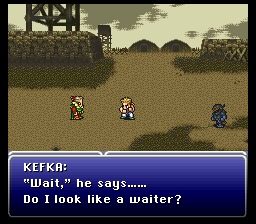
Kefka is really the ideal villain for Woolsey's style, because he's a little kooky and off the beaten path as far as villains go. He isn't self-collected and brooding, like a Magus or a Sephiroth. He's insane and goofy, clever and unpredictable, and more than any other villain in the series, eminently quotable. Kefka never speaks in ellipses. He speaks in awesome.

That's not to say, of course, that I am ratting on the new translation. I love most of what the new translation does, and I think it's worth paying the $30 for a new game just to play the new translation, free from the company's earlier restraints on words like "death," "holy," and "pregnant." However, I don't think it's fair to dismiss Woolsey and the neat things that he did with FF6's translation. I would happily play either version anytime (although FF3us's sound quality is much better.) Godspeed, Ted, wherever you are.


Mr. Cactuar says: This page has had unique visitors since July 6, 2007.